Zaynix Health · for UK clinics and their patients
The health record a patient owns — and a clinic can finally read.
Blood tests, blood-pressure readings, medicines and documents from UK labs and devices, in one longitudinal record. The patient confirms every document import. Every value read from a document links to its source. The clinic sees exactly what the patient sees.
ICO registered ZC117578 · Data hosted in the EEA · Not a medical device: it displays and organises your own record
- kinds of health data in one record — blood, blood pressure, medicines, body, glucose, diagnoses, allergies, DNA, gut, documents and more
- 18
- is confirmed by the patient before it enters the record — a guard on the write path refuses any other route
- Every document import
- of a record are logged, and the patient can see who looked and when
- Clinician reads
- PDF, photo or device export — NHS letters, Medichecks, Randox, TDL, clinic printouts, Hilo and Aktiia monitors; what cannot be read is listed, never dropped
- UK lab reports
The record
Ten years of scattered results, read as one story.
A new patient arrives with NHS printouts, private-lab PDFs, a blood-pressure cuff and a shoebox of letters. Zaynix reads them into a single record the patient owns — and keeps the lab’s own words beside every number read from a report.
Blood tests
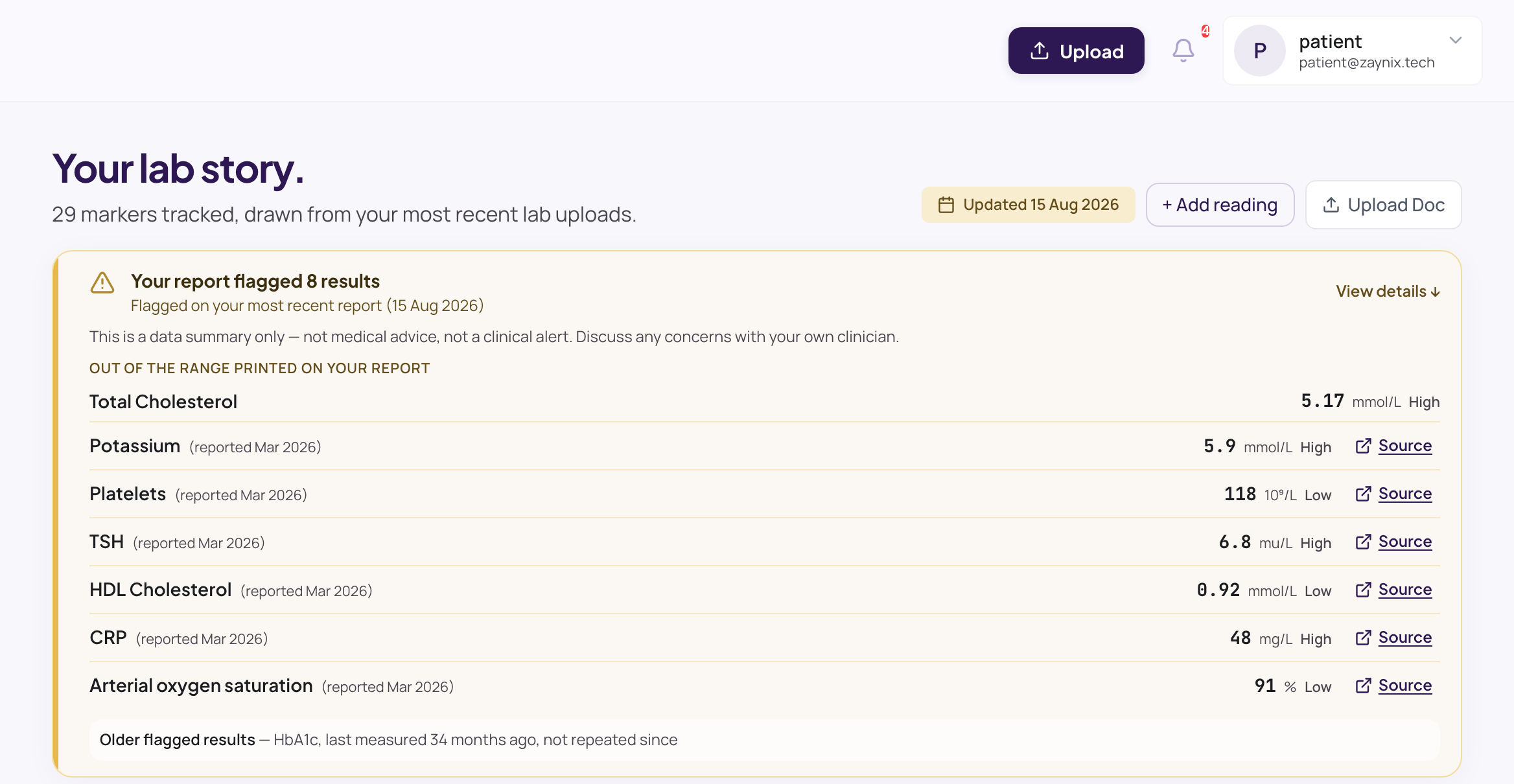
Every marker, with the range printed on the report, across every lab.
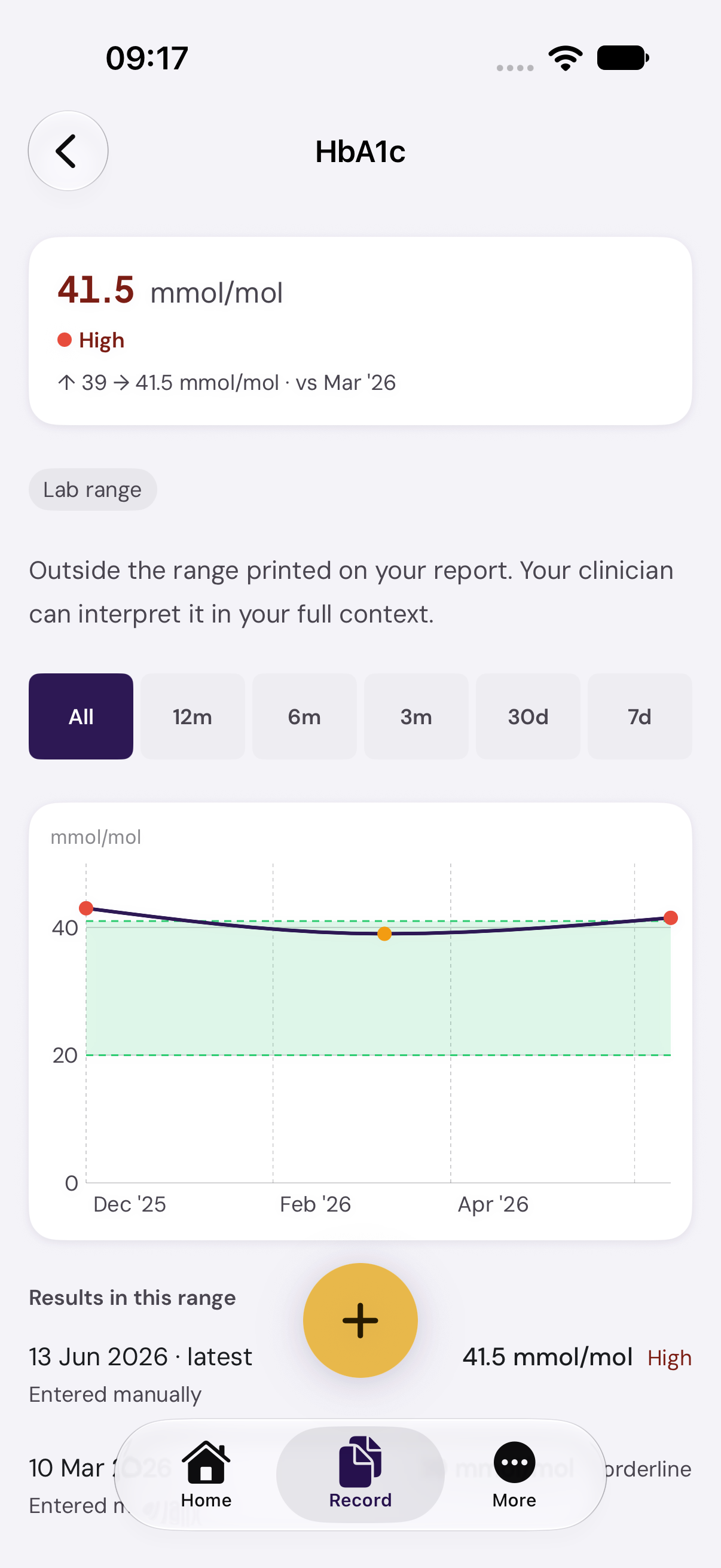
A result on its own tells you little. Zaynix shows how each marker moved, flags what sits outside the range printed on the report (or a general adult range, marked as such, where the report’s could not be read), and quotes the lab’s comment rather than inventing one.
- Reads PDFs and photographs from UK labs; unusual layouts fall back to a flexible extraction engine, and anything unread is listed
- The lab’s printed value and range stay visible; a converted unit is shown as a conversion
- Each result read from a document links to the page it came from
- Trends per marker across years and vendors, with the range alongside
Blood pressure
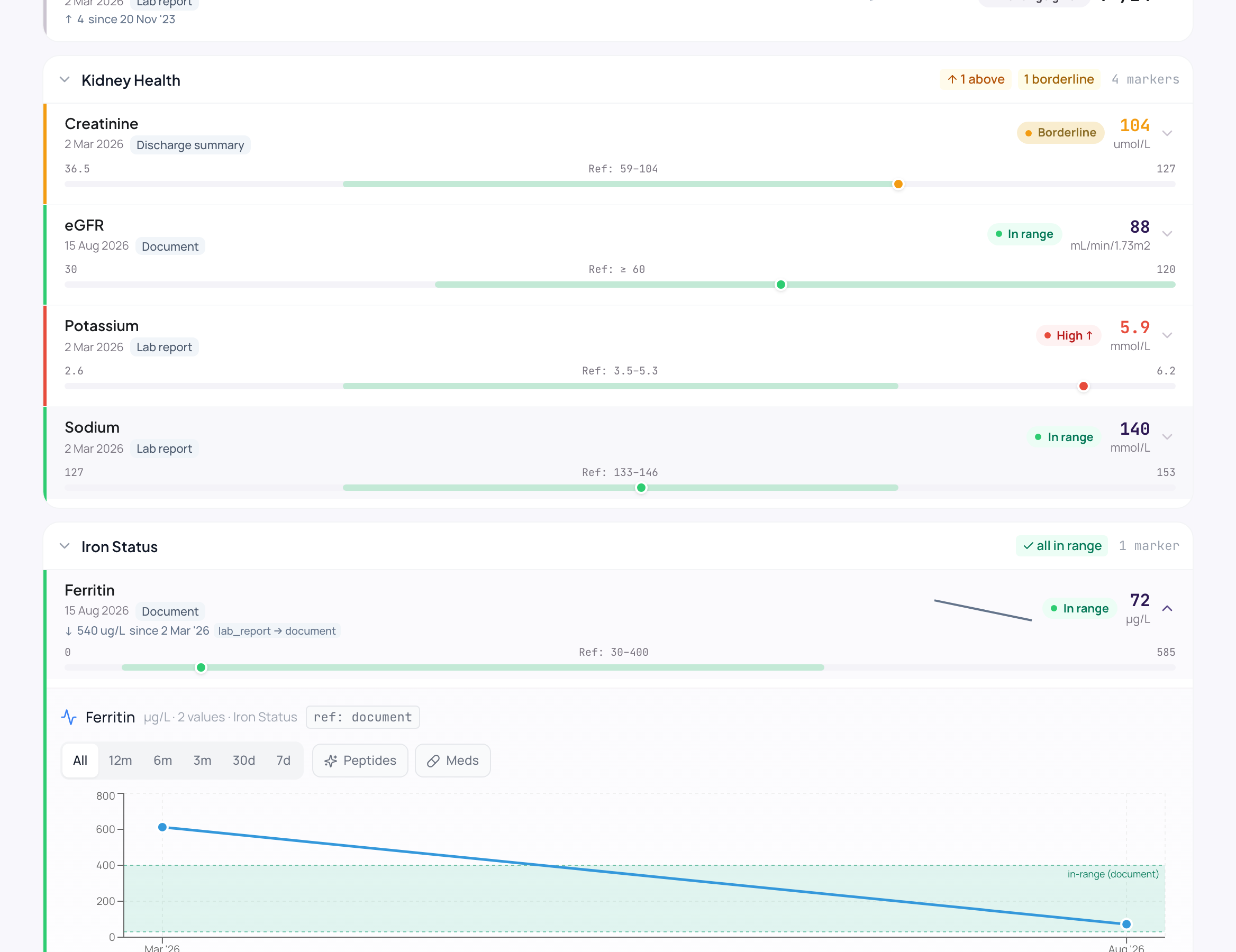
Shown against one reference line — on the readings that belong there.
Home cuffs, clinic readings and 24-hour monitors do not mean the same thing. Zaynix keeps them apart, so a quiet night never softens a high day.
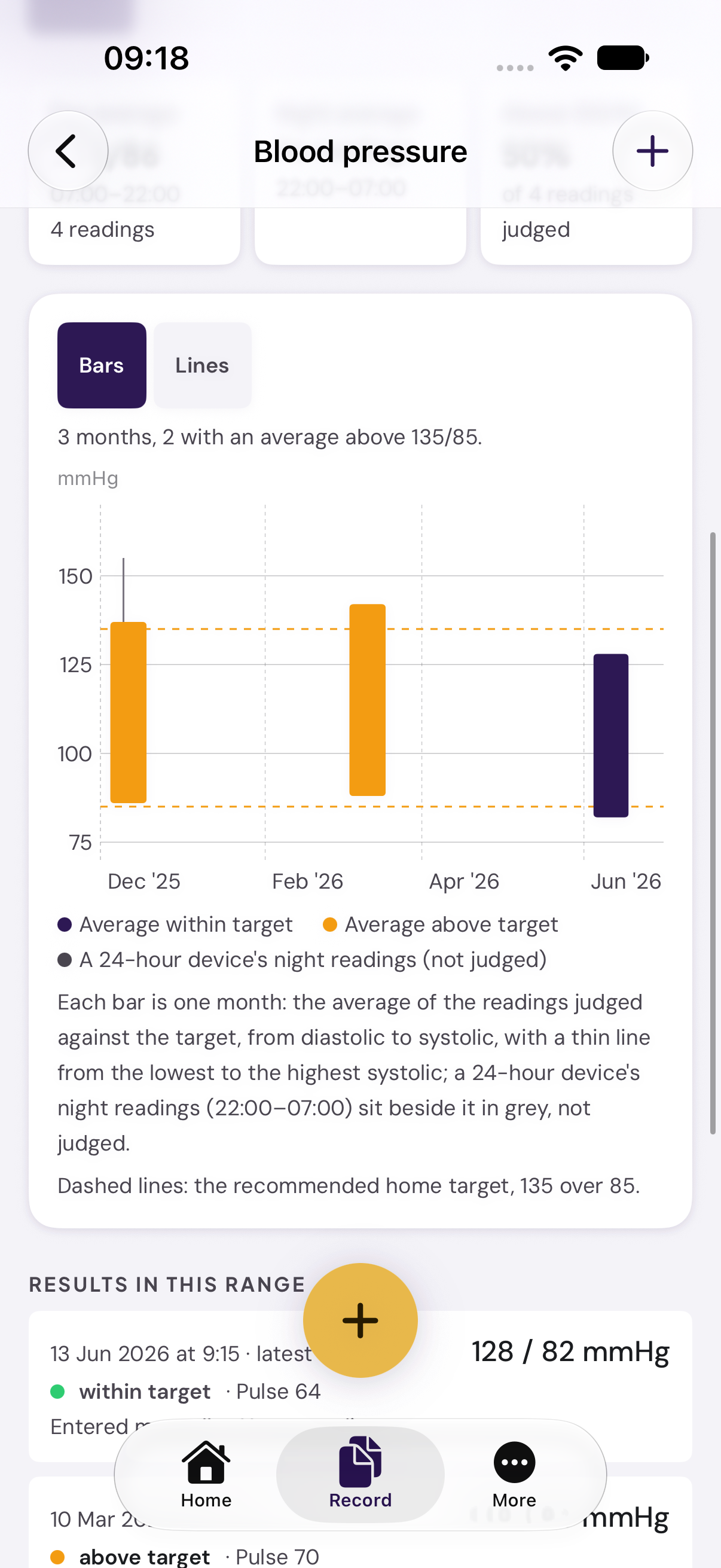
- A bar per day, week or month of the readings a person took, shown against a fixed reference line (NICE NG136: 140/90, or 135/85 at home)
- A 24-hour device’s night readings are kept apart — shown beside the day, never pooled
- Plain words, not a staging label: "above target" means above that line, nothing more
- One rule on the web and the phone, held to the same generated test cases
Medicines and protocols
What was taken, when — as the patient said it.
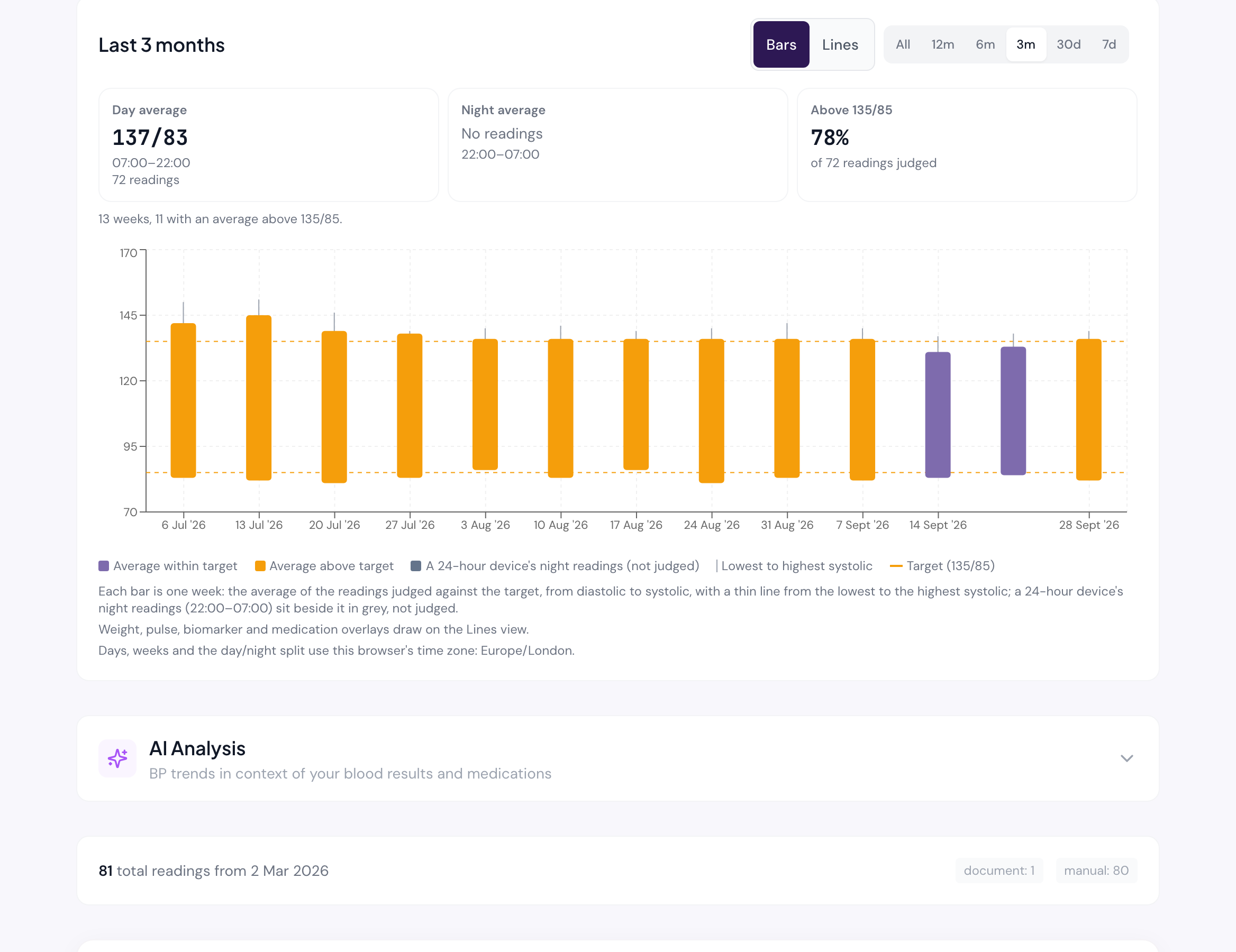
A medicine list that is honest about dates is rarer than it sounds. Zaynix records what the patient said and when they said it, and shows the clinician the same. It draws no conclusion about what a medicine did.
- Prescriptions, supplements, hormones and peptides on one timeline, beside the blood results of the same dates
- Doses logged in the patient’s words; a dose told for an earlier date never moves the card
- Side effects a patient logs reach the clinician’s view of the same medicine
- Cancelled plans are counted apart from stopped ones
The clinician
The same record, opened by the clinic.
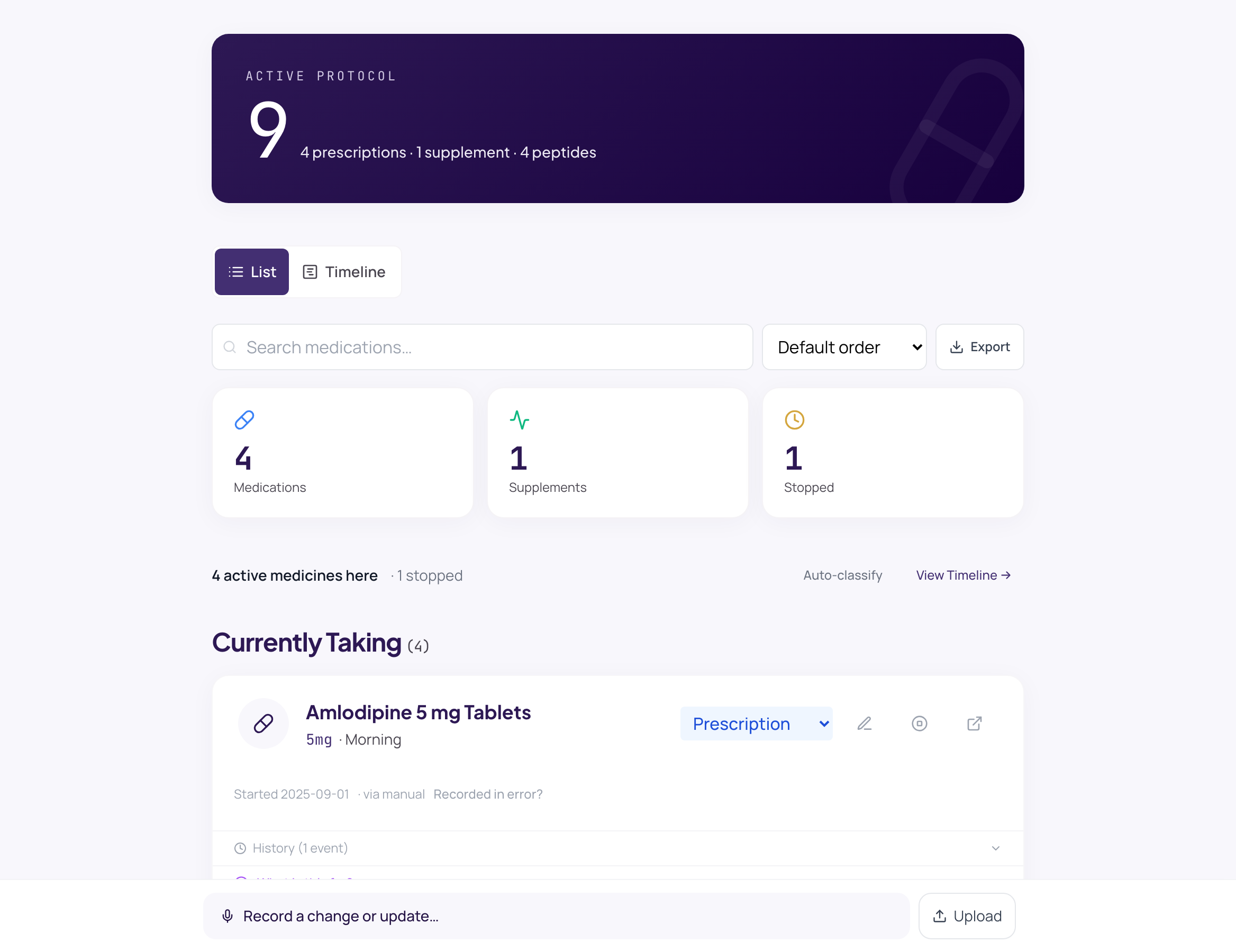
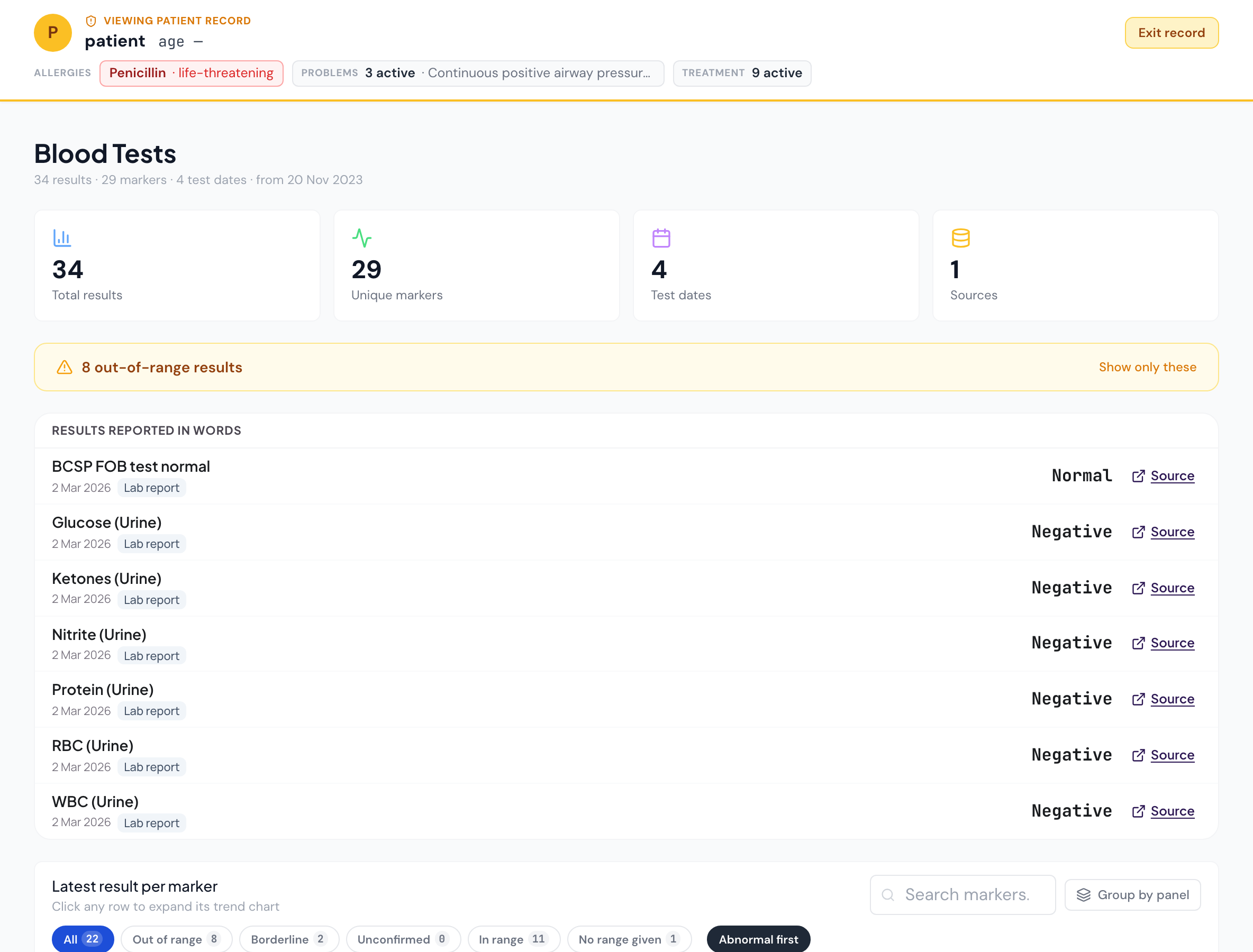
The clinician opens the record itself, not a summary of it. What the clinic adds is marked as the clinic’s, and a clinician’s reads are logged where the patient can see them.
- Every page the patient has, with the same numbers, the same flags and the same source links
- The safety header first: recorded allergies, active problems, active treatment
- Honest counts ("12 most recent of 48") wherever a list is capped
- Clinical notes, care targets and logged doses are the clinic’s; what the patient recorded cannot be edited by anyone else
iPhone
The same record, in the pocket.
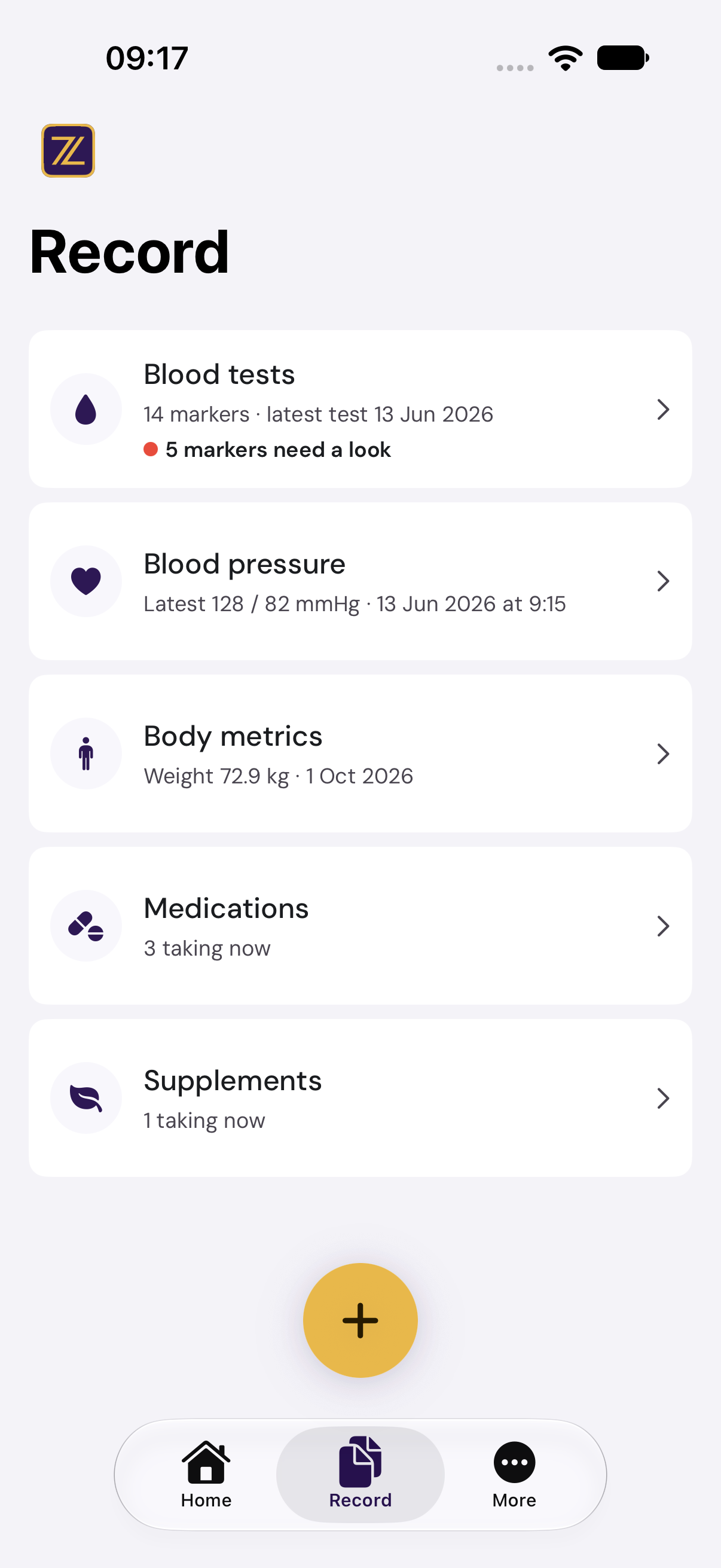
A native iPhone app, built in Swift for patients only. Every screen has its loading, empty, error and loaded state. Nothing from the record is written to the phone’s web cache, and the record is covered in the app switcher.
- The Record hub: every category with its newest value
- Trends, blood pressure bars and lines, medicines, body — the same rules as the web
- Photograph a result and send it for review; it waits in an outbox when offline
- Face ID to open; sign in through the system browser, no password typed into the app
In testing on TestFlight.
Three rules we do not bend
Built so a record can be trusted in six months, not just admired today.
These are not slogans. Each one is enforced in code and checked by tests on every release, and each one is why a clinic can rely on what it reads.
- 01
The patient confirms every document import.
AI reads the document and proposes the values. Nothing read from a document is written to the record until the patient has looked and agreed — a guard on the write path (we call it the Patient Confirmation Layer) refuses any other route.
- 02
Every value says where it came from.
A number read from a document carries the page it came from, the lab’s own printed value and range, and the lab’s own wording; a number typed in by hand is marked as entered by hand. A calculated score quotes the lab’s band word or nothing. No source, no value.
- 03
The clinic sees what the patient sees. Never more.
A connected clinician reads the same record with the same numbers. They can add their own notes, targets and logged doses; they can never alter what the patient recorded. A clinician’s reads are in the patient’s own audit log.
Who it is for
Clinics that read patterns over time — and the people who bring them the results.
Zaynix sits alongside the practice-management software a clinic already runs — it does not connect to it. It is the longitudinal patient-data layer those tools do not try to be.
-
Preventive and longevity clinics
Practices whose work is reading biomarker patterns over years, across whichever labs the patient happened to use.
-
Hormone, menopause and metabolic clinics
Where a dose change and the next blood test belong on the same timeline, and the patient’s own readings matter between visits.
-
People who manage their own health
Patients join through a clinic or by invitation. Every person’s record is their own: they can export it, disconnect a clinic, or ask us to delete it.
Security, briefly
What protects a record — and what is still to come.
A UK data controller (ICO ZC117578), hosted in the EEA, TLS everywhere, a database reachable only from its own server, nightly backups that are restored and counted every night, and an audit trail of every write and every clinician read that the patient can see.
Where the data lives
Hetzner Online GmbH, Falkenstein, Germany (EEA), under the UK’s adequacy regulations for the EEA. Documents and database on the same access-controlled host.
Who can read it
The patient; a clinician the patient has connected to; Zaynix staff only for an operational reason — and when they open a record in the app, that is logged. Clinician reads are listed in the patient’s export.
AI, disclosed
Documents are read by Anthropic’s Claude, or Google’s Gemini on some paths, under the health-data consent given before anything is added to the record; the summaries and the assistant run only after a separate AI consent. The How-we-use-AI page names the models and what each patient-facing feature sends them.
What is not in place yet
Encryption at rest on the host and an off-site backup copy are planned without a date; no certification or penetration test has been scheduled. We say what is done and what is not.
Your rights, built in
Export your record (Article 15) from the Privacy page; ask for deletion and we act on it within one month; see every clinician read of your record.
Under NDA
Current drafts of the DPIA, record of processing, processor register, incident runbook and the infrastructure detail are shared with clinics and investors on request.
The people behind it
Built by a team that has run and fixed health platforms.
Zaynix Health is the product of Zaynix, a UK HealthTech consultancy whose team has worked at the senior end of HealthTech and MedTech for decades. This product has no customer testimonials yet; what clients have said about the consultancy’s work is on its own site.
Thirty minutes, no slides unless you ask.
We would rather understand your workflow than show you a product. Tell us a little about your practice when you write — it helps us prepare.